
Skip to the content

NHB

What changed in the NHB schemes in August 2026

From 21 August 2026 National Horticulture Board assistance is 35% in general areas and 45% in the North Eastern and Himalayan States, Scheduled Areas and specified Union Territories. Cold storage subsidy is capped at ₹2.00 crore, land is no longer an eligible cost, and only one member of a family may ever claim. Fresh applications have been paused since 4 September 2026.

  • Source verified by our team
  • 6 min read
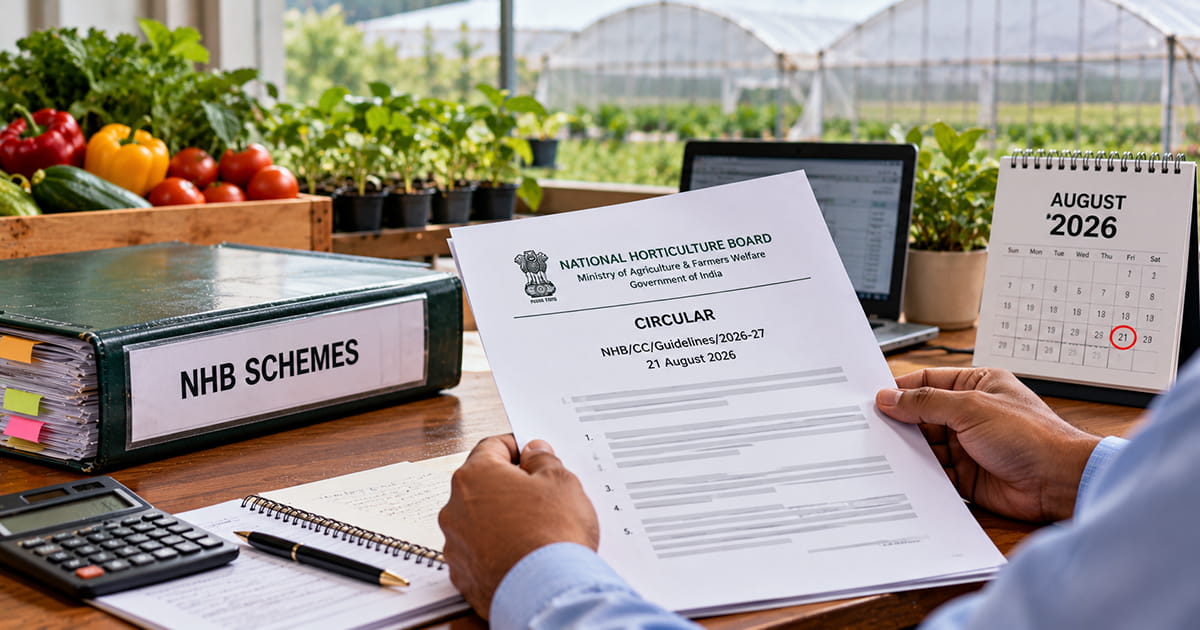
Illustrative image
Ask about this
Source verified by our team
Author Editorial team Reviewer Admin Verified 07 Sep 2026 Applies to NHB Rule period 21 Aug 2026 – current
A reviewer matched the statements on this page to the official documents listed under Sources. It describes our verification work, not an official endorsement. Scheme decisions and approvals rest with the relevant authorities.

Changed on 21 August 2026. The National Horticulture Board revised its rate of assistance to 35% in general areas and 45% in the North Eastern and Himalayan States, Scheduled Areas and specified Union Territories. Cold storage subsidy is now capped at ₹2.00 crore per project, the cost of land no longer counts as eligible project cost, and only one member of a family may ever claim. Fresh applications have also been paused since 4 September 2026.

Applications are paused. The National Horticulture Board suspended fresh Grant of Clearance applications under Scheme No. 1 and Scheme No. 2 for one month from 4 September 2026. The Board has said the resumption date will be notified separately, so there is no fixed reopening date. Check the Board's own website before you plan around this.

Two public circulars in three weeks changed the National Horticulture Board schemes more than the last several years did. If you were working from figures published before August 2026, including the ones that used to be on this site, they are out of date.

The rate dropped

The circular of 21 August 2026 sets a single pair of rates across the Board's components.

Component General areas NER and Himalayan States, Scheduled Areas, specified UTs
Open field cultivation projects 35% 45%
Protected cultivation projects, including plug-type nurseries 35% 45%
New tissue culture units, private sector 35% 45%
Integrated mushroom units 35% 45%
Post-harvest management components 35% 45%
Cold storage projects 35% 45%

The specified Union Territories are the Andaman & Nicobar Islands, the Lakshadweep Islands, Jammu & Kashmir and Ladakh.

For open field projects the old rate was 40%, so the change is modest. For protected cultivation it was 50%, so a grower planning a polyhouse project is looking at roughly a third less assistance than the earlier annexure suggested. Cold storage stays at 35% in general areas, which is where it already was.

The circular is explicit that ceilings and component conditions are unchanged. Only the percentage moved.

Cold storage now has a hard ceiling

No cold storage project, of any type, can draw more than ₹2.00 crore of subsidy from the Board. On a project large enough to reach that ceiling, the 35% rate stops being the binding number.

Land no longer counts

The cost of land is not part of eligible project cost any more. The earlier position allowed newly purchased land into the calculation, capped at 10% of the eligible cost and ₹60,000 per acre. That is gone.

Land development is a different matter and survives. Paragraph 5 is headed “Cost of Land” and removes the cost of land only. The guidelines list Cost of Land and Land Development as separate items, and the eligible-cost formula in both reads “excluding cost of Land and Land Development”, so the two terms are distinct in the drafting. Levelling, digging of pits, fencing and gates remain admissible at actual cost or up to 15% of eligible project cost, capped at ₹60,000 per acre. The circular does not spell this out, so we have recorded it as our reading rather than as the Board's words.

One claim per family, permanently

This is the change most likely to catch someone out. “Family” now means the applicant plus spouse, father, mother, sons and daughters. Only one member of that family may ever take Board assistance, whether directly, through a Hindu Undivided Family, through a partnership or proprietorship firm, or as a director of a company.

Once any one of them has claimed, no other member can claim again under any Board scheme or component, even if the family used only part of the ceiling. The circular calls this the family's final entitlement.

There is one relieving provision. Where a farmer producer organisation, farmer producer company or company has already claimed, its members may still claim once in their own individual capacity.

Applicants have to sign a declaration covering themselves and their family members. Getting it wrong is not treated lightly: suppression or misrepresentation makes the assistance recoverable with interest.

Some people can no longer apply at all

  • Present holders of constitutional posts.
  • Present Ministers and Ministers of State, Members of the Lok Sabha and Rajya Sabha, Members of State Legislative Assemblies and Councils, Mayors of Municipal Corporations, and Chairpersons of District Panchayats.
  • Serving employees of Central and State Government Ministries and Departments, public sector undertakings, autonomous bodies and local bodies, except Multi Tasking Staff, Class IV and Group D employees.
  • Retired pensioners drawing a monthly pension of ₹10,000 or more, again excepting Multi Tasking Staff, Class IV and Group D employees.
  • Groups of farmers.

Family members of people in these categories may still take one-time assistance, subject to the family rule above.

You can now exit voluntarily

A beneficiary may opt out during the lock-in period by refunding the whole subsidy with any applicable interest. Once the Board accepts the refund and the conditions are met, the obligations and restrictions that came with the subsidy fall away. That matters if a project needs to be sold or restructured before the lock-in ends.

Application form charges went up

Project cost Form and brochure
Up to ₹20 lakh ₹2,000
Above ₹20 lakh and up to ₹50 lakh ₹5,000
Above ₹50 lakh and up to ₹100 lakh ₹10,000
Above ₹100 lakh and up to ₹150 lakh ₹15,000
Above ₹150 lakh and up to ₹200 lakh ₹20,000
Above ₹200 lakh ₹50,000

Goods and services tax at 18% is extra.

If your application is already in

Pending Letter of Clearance and Grant of Clearance applications and subsidy claims are to be handled case by case, guided by the letter and spirit of the amended provisions. That is not a promise that the old rate will be honoured, and it is not a statement that it will not be. If you have a live application, ask the Board directly what rate is being applied to it.

What we changed on this site

The National Horticulture Board figures here originally came from Annexure VI of the April 2025 MIDH guidelines. The claims the August 2026 circular replaces are marked superseded: they stay visible with their original citation, but they are no longer presented as current.

Two points the circular does not spell out — whether cold storage modernisation keeps its old rate, and whether land development counts as land — we have settled from the documents themselves and recorded as interpretations, labelled as our reading rather than as the Board's words. Both are worth confirming with the Board before you commit money.

Every statement above links to the circular it came from. If we have read something wrong, use the report form at the bottom of any page.


Sources

National Horticulture Board — Public Circular of 21 August 2026: amendment in the scheme guidelines of the Commercial Horticulture and Cold Storage schemes
National Horticulture Board, Ministry of Agriculture & Farmers Welfare, Government of India · Amendment · 21 Aug 2026 · Current
Official original
National Horticulture Board — Public Circular of 3 September 2026: temporary suspension of fresh Grant of Clearance applications under Scheme No. 1 and Scheme No. 2
National Horticulture Board, Ministry of Agriculture & Farmers Welfare, Government of India · Circular · 03 Sep 2026 · Review due
Official original
Statements checked on this page (13)
  • Source verified by our team For the purpose of determining eligibility under National Horticulture Board schemes, "family" comprises the applicant's spouse, father, mother, sons and daughters. — Page 1, paragraph 1
  • Source verified by our team Only one member of a family is eligible to avail financial assistance under National Horticulture Board schemes, whether individually or through a Hindu Undivided Family, a partnership or proprietorship firm, or as a director of a company. Assistance availed by any member of a family is treated as assistance availed by the same family. — Page 1, paragraph 1
  • Source verified by our team Once financial assistance has been availed by any member of an applicant's family under any National Horticulture Board scheme or component, no further assistance is admissible to any other member of the same family under any scheme or component, irrespective of any unutilised portion of the maximum admissible ceiling. The restriction applies across all Board schemes and components and constitutes the final entitlement of the family. — Page 1, paragraph 1
  • Source verified by our team Where financial assistance has already been availed by a farmer producer organisation, a farmer producer company or a company, its members remain eligible to avail assistance once in their individual capacity, subject to the revised definition of family. — Page 1, paragraph 1
  • Source verified by our team The following are not eligible for financial assistance under National Horticulture Board schemes: present holders of constitutional posts; present Ministers, Ministers of State, Members of the Lok Sabha or Rajya Sabha, Members of State Legislative Assemblies or Councils, Mayors of Municipal Corporations and Chairpersons of District Panchayats; serving employees of Central or State Government Ministries and Departments, public sector undertakings, autonomous bodies and local bodies, except Multi Tasking Staff, Class IV and Group D employees; superannuated or retired pensioners receiving a monthly pension of ₹10,000 or more, excluding Multi Tasking Staff, Class IV and Group D employees; and groups of farmers. — Page 2, paragraph 2
  • Source verified by our team From 21 August 2026 the rate of financial assistance under National Horticulture Board schemes is 35% in general areas and 45% in the North Eastern and Himalayan States, Scheduled Areas and specified Union Territories. The same pair of rates is listed for open field cultivation projects, protected cultivation projects including plug-type nurseries under protected conditions, new tissue culture units in the private sector, integrated mushroom units, post-harvest management components including secondary primary processing, and cold storage projects. — Page 2, paragraph 3, rate table
  • Source verified by our team Under the revised provisions the National Horticulture Board provides credit-linked back-ended subsidy for cold storage at 35% of the eligible project cost in general areas, and 45% in the North Eastern and Himalayan States, Scheduled Areas, Vibrant Villages, the Andaman & Nicobar Islands and the Lakshadweep Islands. The maximum subsidy admissible from the Board for any type of cold storage project must not exceed ₹2.00 crore. — Page 3, paragraph 4
  • Source verified by our team Under the revised provisions the cost of land is not considered as part of the eligible project cost for National Horticulture Board assistance. — Page 3, paragraph 5
  • Source verified by our team A beneficiary may, during the prescribed lock-in period, voluntarily opt out of the scheme by refunding the entire subsidy amount along with applicable interest, if any, as prescribed under the scheme or decided by the competent authority. Once the refund is accepted by the National Horticulture Board and the prescribed conditions are met, the beneficiary is discharged from the obligations and restrictions arising from the subsidy. — Page 3, paragraph 6
  • Source verified by our team The revised cost of the National Horticulture Board application form and scheme brochure runs by project cost: ₹2,000 up to ₹20 lakh; ₹5,000 above ₹20 lakh and up to ₹50 lakh; ₹10,000 above ₹50 lakh and up to ₹100 lakh; ₹15,000 above ₹100 lakh and up to ₹150 lakh; ₹20,000 above ₹150 lakh and up to ₹200 lakh; and ₹50,000 above ₹200 lakh. Goods and services tax at 18% applies in addition. — Page 3, paragraph 7, fee table
  • Source verified by our team The amended provisions came into force with immediate effect. All ongoing and pending Letter of Clearance and Grant of Clearance applications and subsidy claims are to be dealt with by the National Horticulture Board on a case-to-case basis, guided by the letter and spirit of the amended provisions and the directions of the competent authority. — Page 4, paragraph 9
  • Source verified by our team The receipt of fresh applications for Grant of Clearance under National Horticulture Board Scheme No. 1 and Scheme No. 2 is temporarily suspended for a period of one month with effect from 4 September 2026, to allow orderly implementation of the revised guidelines including verification of pending cases and updating of the online application system. During that period the online facility for submitting fresh Grant of Clearance applications remains unavailable. — Page 1, paragraphs 2 and 3
  • Source verified by our team The temporary suspension applies only to the submission of fresh Grant of Clearance applications. Cases already submitted to the National Horticulture Board before the suspension began continue to be dealt with in accordance with the applicable provisions of the revised scheme guidelines and other instructions issued by the Board from time to time. — Page 1, paragraph 4
Version history (9)
DateChangeReasonStatus
14 Oct 2026 Updated — Source verified by our team
08 Sep 2026 Typographic consistency: verbatim quotation now uses the same curly quotes as the rest of the prose. — Source verified by our team
08 Sep 2026 Removed the link that pointed this page at itself. The notice is shared with the six NHB guides, where the link is useful; on the page it points to it is not. — Source verified by our team
07 Sep 2026 Bulk approved by the owner (7 Sep 2026), not a line-by-line review — Source verified by our team
07 Sep 2026 Open questions on cold storage modernisation and land development settled from the sources — Awaiting verification
07 Sep 2026 Rates corrected after the NHB circular of 21 August 2026 — Awaiting verification
07 Sep 2026 Created — Awaiting verification
Report an issue

Spotted something outdated or wrong? Tell us what and, if possible, where the correct information is. No account or phone number needed.

Frequently Asked Questions

35% in general areas and 45% in the North Eastern and Himalayan States, Scheduled Areas and the specified Union Territories, across every listed component. The circular is explicit that ceilings and component conditions are unchanged; only the percentage moved.

No. Only one member of a family may ever take Board assistance, and family means the applicant plus spouse, father, mother, sons and daughters. Once any one of them has claimed, no other member can claim again under any Board scheme or component, even if the family used only part of the ceiling.

Fresh Grant of Clearance applications under Scheme No. 1 and Scheme No. 2 have been suspended since 4 September 2026. The Board has said the resumption date will be notified separately, so there is no fixed reopening date. Check the Board's own website before you plan around this.

Pending Letter of Clearance and Grant of Clearance applications and subsidy claims are to be handled case by case, guided by the letter and spirit of the amended provisions. That is not a promise the old rate will be honoured, and not a statement that it will not be. Ask the Board directly what rate is being applied.

