
This one is our reading, not a quoted rule. Everything below is a comparison of documents anyone can open, and the paragraph numbers are given so you can check it. No reviewer has been through it, which is why this page is marked awaiting verification rather than source verified. We would rather publish it with that label than hold it back: the comparison is checkable by anyone with the two documents open.
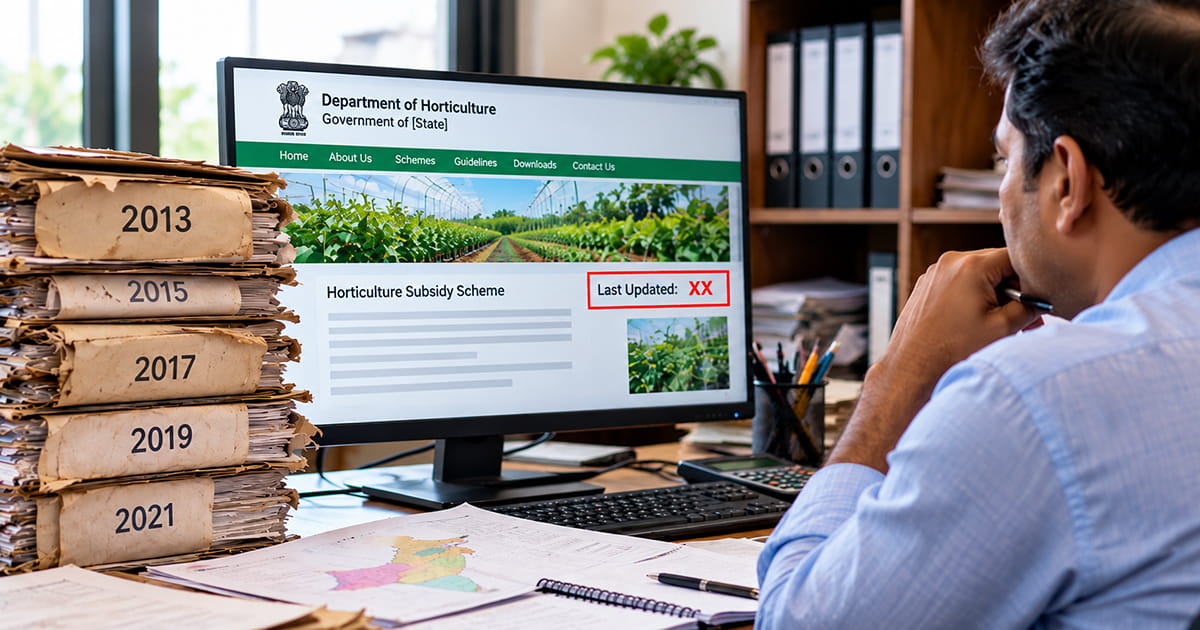
If you have searched for your state's horticulture subsidy and landed on the state department's own website, you have probably read figures that are eleven years old. This is not a guess. We compared four state pages against the national guidelines, and in every case the state's numbers came from an edition that was replaced in April 2025.
What we compared
Three documents, all public:
- The MIDH operational guidelines of April 2025, which are the national rules in force. This site takes 64 sourced statements from them, and every figure in our guides names the page it came from.
- The April 2014 edition of the same national document. The Madhya Pradesh horticulture department publishes a full copy of it, which is how we came to have one.
- The state pages themselves.
Kerala
The Kerala State Horticulture Mission publishes a scheme details page with rates on it. Three of them line up with the 2014 edition rather than the current one.
| Component | What Kerala's page says | Where it comes from |
|---|---|---|
| Rejuvenation of senile plantations | 50% of cost, limited to 2 hectares | Paragraph 7.20 of the 2014 guidelines, in the same words |
| Organic farming | ₹10,000 per hectare, 4 hectares, over three years, over and above area expansion | Paragraph 7.30 of the 2014 guidelines |
| Vermicompost | ₹50,000 for a unit of 30′ × 8′ × 2.5′ | The same paragraph, matching to the inch |
The current guidelines say something different about the first two. Rejuvenation is 40% against cost norms of ₹10,000 and ₹40,000 per hectare. Organic farming carries no NHM figure at all — the guidelines send it to PKVY norms.
Uttarakhand
The State Horticulture Mission there publishes cost norms dated 2014-15. Its nursery figures match the 2014 national annexure to the rupee.
| Component | Uttarakhand's 2014-15 norms | National, April 2025 |
|---|---|---|
| Hi-tech nursery | ₹25.00 lakh per hectare, capped at ₹100 lakh | ₹30 lakh per hectare for 1 to 2 hectares |
| Small nursery | ₹15.00 lakh per hectare, credit compulsory | ₹20 lakh per hectare for 0.4 to 1 hectare |
Note which way that runs. The state's published figures are lower than the ones in force, not higher. Anyone budgeting from that page would understate what the scheme now recognises.
Puducherry and Madhya Pradesh
Puducherry's scheme page describes the central government's share as 85%, with 15% from the state and 100% for the North Eastern and Himalayan states. The current guidelines say 60:40, and 90:10 for those states. That is a budget split between governments rather than a rate paid to a grower, so it will not cost you money directly — but it dates the page.
Madhya Pradesh is the plainest case. The document its department offers under the heading "Guidelines" is the April 2014 national edition itself.
Why this happens
Nobody is being dishonest. A state department writes a scheme page when a scheme launches, the national guidelines are revised years later, and the page is never rewritten because rewriting it is nobody's specific job. The same thing happens to printed leaflets and to the district office's notice board.
It matters because of what a cost norm is. A cost norm is a ceiling used in an arithmetic step, so a stale norm does not merely mislead you about the percentage — it changes the number you are entitled to, in either direction.
How to tell whether a page is current
- Look for a date. Not the copyright line at the bottom, which updates itself, but a date on the scheme content. Kerala's page has none at all.
- Look for an order number. A state that has actually decided something issues a Government Order or a notification and cites it. Odisha's cold storage scheme names its notification and its date on the front page.
- Check the area cap. This is the quickest test we found. Where the current guidelines use 2 hectares per beneficiary, the 2014 edition often used 4. A page offering 4 hectares on a component the national document caps at 2 is very likely written to the old edition.
- Compare one figure against the national document. If a single number matches the 2014 edition exactly, assume the rest of the page does too.
What to do about it
Work from the national guidelines of April 2025 for the components they cover, and treat a state figure as out of date until it carries a date or an order number that says otherwise. Where a state genuinely does add to the national norm from its own budget — which states are allowed to do — it will be able to point you at the order that authorises it. Ask for that order before you plan around the difference.
And if you find a state page that is current, or an order that genuinely varies the national norms, tell us. That is a page worth writing.



