
Skip to the content

NHM · Protected cultivation

Does NHM give 50% subsidy?

No single rate applies. Protected cultivation is generally 50%, most field crops 40%, INM and IPM 30%, and most large post-harvest projects 35%. The rate is set component by component, and always with a ceiling attached.

  • Source verified by our team
  • 2 min read
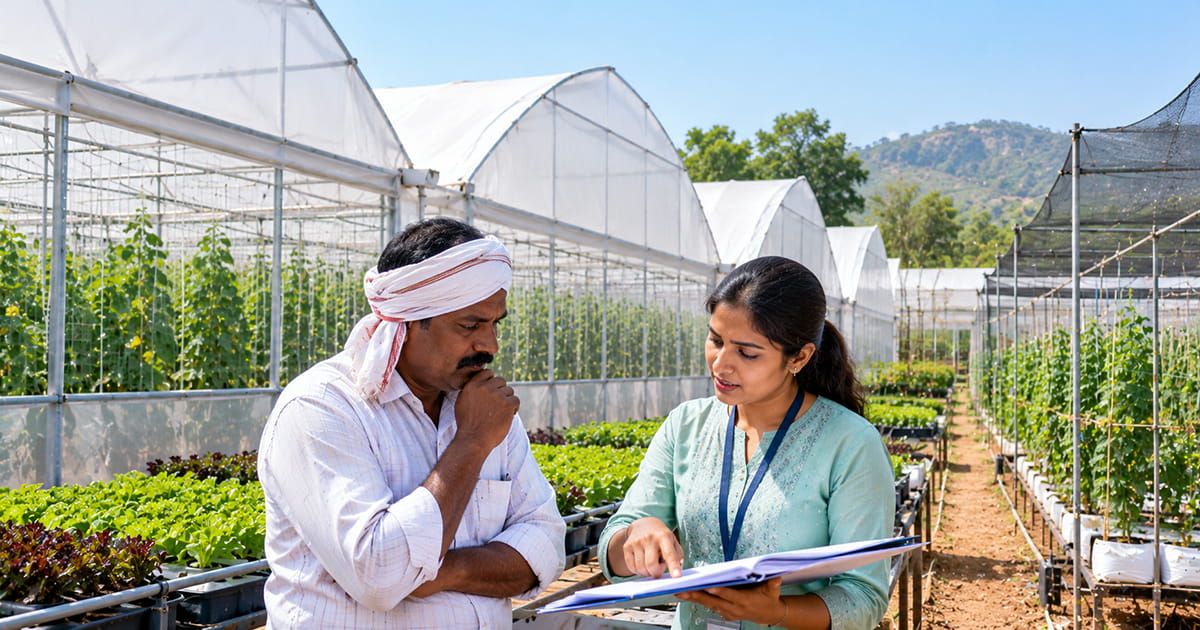
Illustrative image
Ask about this
Source verified by our team
Author Editorial team Reviewer Admin Verified 07 Sep 2026 Applies to NHM · Protected cultivation Rule period 01 Apr 2025 – current
A reviewer matched the statements on this page to the official documents listed under Sources. It describes our verification work, not an official endorsement. Scheme decisions and approvals rest with the relevant authorities.

What people are told

NHM gives 50% subsidy on horticulture projects.

What the document says

Depends on context

The guidelines set the pattern of assistance separately for each component. Protected cultivation components are generally assisted at 50%. Most field crop area-expansion components are at 40% in general areas. Integrated nutrient and pest management is at 30%. Most large post-harvest and cold-chain projects are at 35% credit-linked back-ended. A farm gate pack house is at 50%.

Exceptions and conditions

Every rate is paired with a ceiling: 2 hectares for most field components, 4,000 square metres for the main protected-cultivation components, 6 fans for circulation fans, 1,000 running metres for fencing, and 5,000 MT for cold storage subsidy under NHM. Public-sector applicants are treated differently from private-sector ones for several components. Rates also differ outside general areas.

Before you spend money: cost norms, rates and conditions can be changed by the Government. This page explains the April 2025 MIDH operational guidelines as written. Confirm the current position with your State Horticulture Department before committing to a project.

This is the most repeated sentence about the scheme, and it is the reason a lot of project plans do not survive their first meeting with the department.

Where the confusion starts

Two different numbers get mixed up. The Government of India contributes 60% of the programme outlay in general States, with the State contributing 40%. That is a budget-sharing arrangement between governments. It says nothing about what an individual beneficiary receives.

Separately, 50% is a real rate, but only for certain components. Protected cultivation is the main one, which is why anyone selling polyhouses quotes it.

What the rates actually are

Component group General-area assistance
Protected cultivation structures, crops inside them, and add-ons 50%
Fruit, vegetable, flower, spice and medicinal area expansion 40%
Rejuvenation of old orchards 40%
Integrated nutrient and pest management 30%
Most large post-harvest and cold-chain projects 35%, credit-linked back-ended
Farm gate pack house, low-cost onion storage 50%

The percentage is only half the answer

Every rate comes with a ceiling, and the ceiling usually decides the money more than the percentage does. Fifty percent of a cost norm, capped at 4,000 square metres, is a very different figure from fifty percent of your quotation.

A better question

Instead of “what percentage does NHM give”, ask: which component covers my project, what is its cost norm, what is the rate for my category, and what is the maximum area or capacity. Those four answers give a number you can plan with.

Protected cultivation is where the gap between the rate and the reality is widest, because the structures cost far more than their norms. We have worked it through for polyhouses and net houses: the same 50% rule returns roughly 50%, 35% and 16% depending on which structure you build.


Sources

Mission for Integrated Development of Horticulture (MIDH) — Operational Guidelines, April 2025
Horticulture Division, Department of Agriculture & Farmers Welfare, Ministry of Agriculture & Farmers Welfare, Government of India · Guideline · 01 Apr 2025 · Current
Official original
Statements checked on this page (6)
  • Source verified by our team The Government of India contributes 60% of the total outlay for developmental programmes in all States except those in the North East and Himalayan region, where the share is higher. This 60:40 split is how the programme budget is shared between the Centre and the State; it is not the rate of assistance an individual beneficiary receives. — Printed p. 1 (PDF page 11), Annexure V and related sections
  • Source verified by our team The guidelines state that "cost norms means upper limit of cost for calculation of subsidy". A cost norm is therefore the maximum cost recognised when calculating assistance for a component, and is not a statement of the market price of a project. — Printed p. 60 (PDF page 70), Annexure V and related sections
  • Source verified by our team Assistance for a fan and pad polyhouse is 50% of the cost norm, for a maximum area of 4,000 square metres per beneficiary. — Printed p. 43 (PDF page 53), Annexure V and related sections
  • Source verified by our team For hybrid vegetables, the cost norm is ₹60,000 per hectare, with assistance at 40% in general areas for an area up to 2 hectares per beneficiary. — Printed p. 38 (PDF page 48), Annexure V and related sections
  • Source verified by our team For integrated nutrient management and integrated pest management, the cost norm is ₹5,000 per hectare with assistance at 30%, for a maximum of 2 hectares per beneficiary. — Printed p. 47 (PDF page 57), Annexure V and related sections
  • Source verified by our team Post-harvest and cold-chain projects such as cold storage, pack houses and refrigerated transport are entrepreneur-driven and generally use the credit-linked back-ended assistance system rather than direct payment. — Printed p. 17 (PDF page 27), Annexure V and related sections
Version history (4)
DateChangeReasonStatus
14 Oct 2026 Updated — Source verified by our team
09 Sep 2026 Linked the polyhouse and net house cost comparison, so the protected-cultivation guides point at each other rather than each ending on its own. — Source verified by our team
07 Sep 2026 Bulk approved by the owner (7 Sep 2026), not a line-by-line review — Source verified by our team
07 Sep 2026 Created — Awaiting verification
Report an issue

Spotted something outdated or wrong? Tell us what and, if possible, where the correct information is. No account or phone number needed.

Frequently Asked Questions

Neither figure is a general answer. 60:40 is how the programme budget is shared between the Centre and the State, not what a beneficiary receives. 50% applies to protected cultivation components. Most field crop components are 40%, INM and IPM is 30%, and most large post-harvest projects are 35%.

Protected cultivation structures, the crops grown inside them, and the protected cultivation add-ons. A farm gate pack house and low-cost onion or garlic storage are also at 50%.

No. Every rate comes with a ceiling on area, capacity or units, and the ceiling usually decides the amount more than the percentage does.

