
Skip to the content

NHM · Protected cultivation

Polyhouse subsidy under NHM: fan and pad, naturally ventilated, and the 4,000 square metre ceiling

There is no single polyhouse subsidy. Fan and pad and naturally ventilated structures carry different cost norms, both fall as the area grows, both are assisted at 50%, and both are capped at 4,000 square metres per beneficiary.

  • Source verified by our team
  • 3 min read
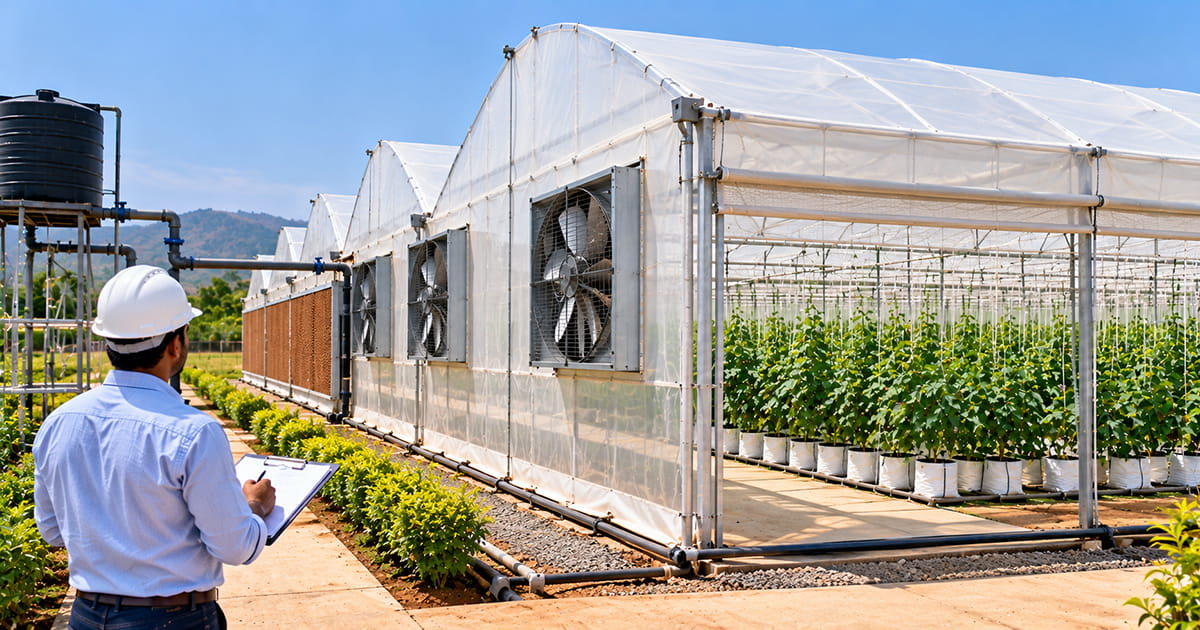
Illustrative image
Ask about this
Source verified by our team
Author Editorial team Reviewer Admin Verified 07 Sep 2026 Applies to NHM · Protected cultivation Rule period 01 Apr 2025 – current
A reviewer matched the statements on this page to the official documents listed under Sources. It describes our verification work, not an official endorsement. Scheme decisions and approvals rest with the relevant authorities.

Before you spend money: cost norms, rates and conditions can be changed by the Government. This page explains the April 2025 MIDH operational guidelines as written. Confirm the current position with your State Horticulture Department before committing to a project.

“What is the polyhouse subsidy?” has no single answer, because the guidelines do not treat a polyhouse as one thing. The type of structure, and its size, both change the figure.

Fan and pad polyhouse

A fan and pad system draws air across a wet pad with exhaust fans, giving closer climate control. It carries the highest cost norms, on a sliding scale.

Area Cost norm
Up to 500 m² ₹1,800 per m²
Above 500 and up to 1,008 m² ₹1,600 per m²
Above 1,008 and up to 2,080 m² ₹1,500 per m²
Above 2,080 and up to 4,000 m² ₹1,450 per m²

Assistance is 50% of the cost norm, for a maximum area of 4,000 square metres per beneficiary.

Naturally ventilated polyhouse

A naturally ventilated structure relies on roof and side vents rather than powered cooling. For tubular or rectangular construction:

Area Cost norm
Up to 500 m² ₹1,200 per m²
Above 500 and up to 1,008 m² ₹1,050 per m²
Above 1,008 and up to 2,080 m² ₹1,000 per m²
Above 2,080 and up to 4,000 m² ₹950 per m²

Assistance is again 50%, with the same 4,000 square metre ceiling.

Bamboo and cable purlin structures

A lower-cost bamboo or cable-purlin structure carries a cost norm of ₹450 per square metre with assistance at 50%. The guidelines restrict bamboo structures to a stated number of units per beneficiary, each of a stated maximum size, so a single large bamboo house is not the way this component is meant to be used.

The ceiling is the number that plans your project

4,000 square metres is roughly one acre. Beyond it, the structure can be as large as you like, but the assistance stops. When people say “subsidy on one acre of polyhouse”, this ceiling is where the phrase comes from.

Two conditions that catch people out

  • Materials must meet standards. The guidelines require materials and technologies used for subsidised protected cultivation to conform to BIS standards.
  • The structure is not the whole project. The crop grown inside it, and add-ons such as fans and fertigation automation, are separate components with their own norms. That is covered in the companion explanations.

What none of this tells you is what you will actually pay. A cost norm is a ceiling for the calculation, and the market price of a polyhouse sits well above it — far enough that the headline 50% returns about 35% on a naturally ventilated house and about 16% on fan and pad. That comparison, worked at the 4,000 square metre limit, is here.


Sources

Mission for Integrated Development of Horticulture (MIDH) — Operational Guidelines, April 2025
Horticulture Division, Department of Agriculture & Farmers Welfare, Ministry of Agriculture & Farmers Welfare, Government of India · Guideline · 01 Apr 2025 · Current
Official original
Statements checked on this page (12)
  • Source verified by our team For subsidy assistance on protected cultivation, all materials and technologies used should conform to BIS standards. — Printed p. 13 (PDF page 23), Annexure V and related sections
  • Source verified by our team For a fan and pad polyhouse, the cost norm is ₹1,800 per square metre for an area up to 500 square metres. — Printed p. 43 (PDF page 53), Annexure V and related sections
  • Source verified by our team For a fan and pad polyhouse, the cost norm is ₹1,600 per square metre for an area above 500 and up to 1,008 square metres. — Printed p. 43 (PDF page 53), Annexure V and related sections
  • Source verified by our team For a fan and pad polyhouse, the cost norm is ₹1,500 per square metre for an area above 1,008 and up to 2,080 square metres. — Printed p. 43 (PDF page 53), Annexure V and related sections
  • Source verified by our team For a fan and pad polyhouse, the cost norm is ₹1,450 per square metre for an area above 2,080 and up to 4,000 square metres. — Printed p. 43 (PDF page 53), Annexure V and related sections
  • Source verified by our team Assistance for a fan and pad polyhouse is 50% of the cost norm, for a maximum area of 4,000 square metres per beneficiary. — Printed p. 43 (PDF page 53), Annexure V and related sections
  • Source verified by our team For a naturally ventilated polyhouse of tubular or rectangular construction, the cost norm is ₹1,200 per square metre for an area up to 500 square metres. — Printed p. 44 (PDF page 54), Annexure V and related sections
  • Source verified by our team For a naturally ventilated polyhouse of tubular or rectangular construction, the cost norm is ₹1,050 per square metre for an area above 500 and up to 1,008 square metres. — Printed p. 44 (PDF page 54), Annexure V and related sections
  • Source verified by our team For a naturally ventilated polyhouse of tubular or rectangular construction, the cost norm is ₹1,000 per square metre for an area above 1,008 and up to 2,080 square metres. — Printed p. 44 (PDF page 54), Annexure V and related sections
  • Source verified by our team For a naturally ventilated polyhouse of tubular or rectangular construction, the cost norm is ₹950 per square metre for an area above 2,080 and up to 4,000 square metres. — Printed p. 44 (PDF page 54), Annexure V and related sections
  • Source verified by our team Assistance for a naturally ventilated polyhouse is 50% of the cost norm, for a maximum area of 4,000 square metres per beneficiary. — Printed p. 44 (PDF page 54), Annexure V and related sections
  • Source verified by our team For a bamboo or cable-purlin naturally ventilated structure, the cost norm is ₹450 per square metre with assistance at 50%. The guidelines limit this to a stated number of units per beneficiary, each of a stated maximum size; confirm the exact unit limit on the page before relying on it. — Printed p. 44 (PDF page 54), Annexure V and related sections
Version history (6)
DateChangeReasonStatus
14 Oct 2026 Updated — Source verified by our team
09 Sep 2026 Linked the polyhouse and net house cost comparison, so the protected-cultivation guides point at each other rather than each ending on its own. — Source verified by our team
07 Sep 2026 Bulk approved by the owner (7 Sep 2026), not a line-by-line review — Source verified by our team
07 Sep 2026 Updated — Awaiting verification
07 Sep 2026 Updated — Source verified by our team
07 Sep 2026 Created — Awaiting verification
Report an issue

Spotted something outdated or wrong? Tell us what and, if possible, where the correct information is. No account or phone number needed.

Frequently Asked Questions

One acre is close to the 4,000 square metre ceiling. Assistance is 50% of the cost norm for the applicable area slab, not 50% of your quotation. For a naturally ventilated polyhouse the slab above 2,080 square metres carries a cost norm of ₹950 per square metre.

The guidelines use sliding scales for both polyhouse types, so the recognised cost per square metre is lower for larger structures.

The NHM component stops there. A larger protected cultivation project is looked at under the NHB route instead, in project mode with a bank loan.

Yes, as a separate component with its own cost norm. Planting material and cultivation of high-value vegetables carries ₹150 per square metre at 50%.

