
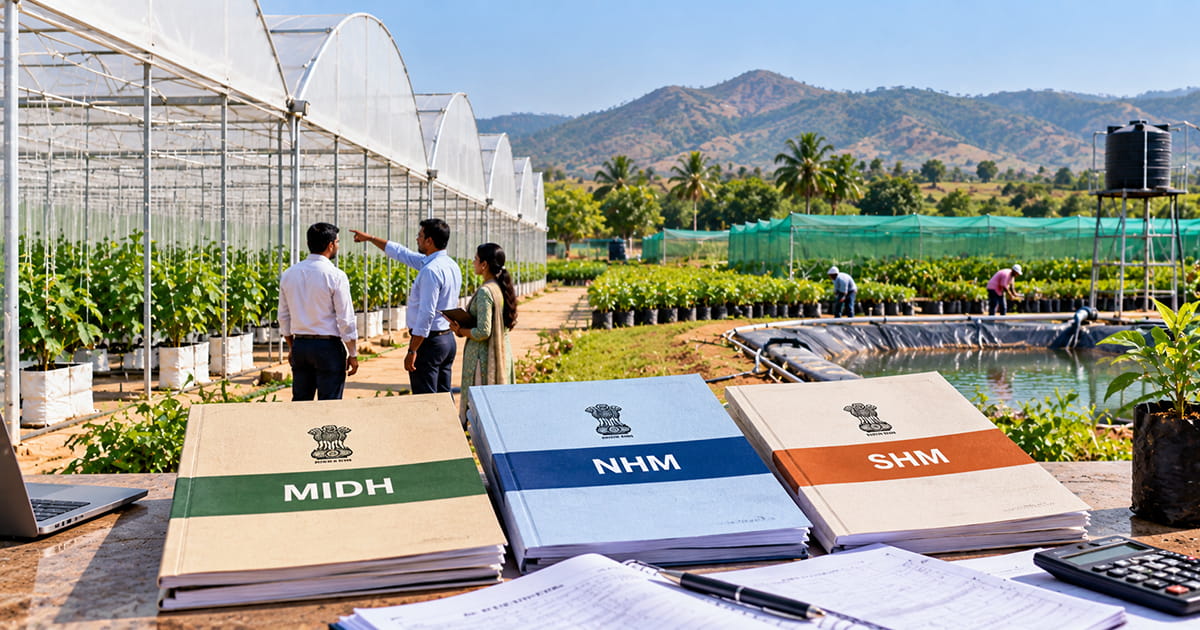
Before you spend money: cost norms, rates and conditions can be changed by the Government. This page explains the April 2025 MIDH operational guidelines as written. Confirm the current position with your State Horticulture Department before committing to a project.
Most confusion about horticulture subsidy starts with the names. One page says MIDH, another says NHM, a third says State Horticulture Mission. They are not three different schemes competing for your application.
The three names
MIDH is the Mission for Integrated Development of Horticulture. It is the umbrella programme covering fruits, vegetables, flowers, spices, mushrooms, medicinal and aromatic plants, nurseries, protected cultivation, water sources, beekeeping, mechanisation, post-harvest facilities and marketing.
NHM, the National Horticulture Mission, is a sub-scheme under MIDH. The guidelines state that NHM covers all States and Union Territories except those in the North Eastern and Himalayan region, and covers all districts in the States it applies to. So for most of the country, NHM is the sub-scheme an application sits under.
SHM, the State Horticulture Mission, is the State-level machinery. It prepares plans, receives funds, releases them to implementing organisations and monitors progress. At district level, a District Mission Committee handles project formulation, implementation and monitoring.
The order to remember
MIDH is the mission. NHM is the sub-scheme that applies to you. SHM and the district committee are who you actually deal with.
The 60:40 figure is not your subsidy
You will often see “60:40” quoted alongside NHM. That is how the programme budget is shared between the Centre and the State, not the rate of assistance paid to a beneficiary. The Government of India contributes 60% of the total outlay for developmental programmes in general States.
What you receive depends entirely on the component you apply under. It may be 30%, 35%, 40% or 50%. Anyone quoting a single “NHM subsidy percentage” has skipped the part that matters.
Where progress is tracked
States are required to maintain their own website, link it to the MIDH SURAKSHA Portal, update progress there and file monthly reports. The guidelines describe SURAKSHA as a monitoring and reporting system for implementing agencies. Treat claims about what it does for an individual applicant with caution unless your State department confirms them.



